




• +1 (216) 452-0909
  • icon-freepik-seeding
  • Environments

    Sustainably Enhanced 1860

  • icon-freepik-medal
  • LEED

    Platinum 9

  • icon-freepik-placeholder
  • Countries

    10

Creating a Sustainability Roadmap

for the Future

How Emerald is helping First Financial Bank become a sustainability leader in the banking industry

Sustainability Leader

First Financial Bank approached Emerald with a request to develop a plan for the financial institution to enhance its sustainability practices, generally referred to as a Sustainability Roadmap. Throughout 2021, Emerald evaluated and analyzed current practices across the bank’s multi-state footprint to understand the company’s values and cultural importance of sustainability and developed a plan with short-term and long-term goals for the bank to reach its sustainability vision.


As a result, the bank now has:

  • Energy & utility use data across all facilities

  • Step-by-step plan to improve facility energy efficiency

  • A template for successful stakeholder engagement driven by shared values


ABOUT FIRST FINANCIAL BANK

line-3-1

Originally chartered in 1863 as First National Bank of Hamilton (in Hamilton, Ohio), the bank now has over 100 locations across Ohio, Indiana, and Kentucky. First Financial Bank has always been deeply committed to its clients and communities, leading them to explore their impact on the environment.


A recent employee survey about sustainability values produced comparatively high engagement. It indicated that sustainability is a priority among employees and that they share a common value of stewardship.

THE CHALLENGE
Emerald

The financial industry has begun to feel increasing external pressures related to climate change and sustainability issues. In addition to risks associated with physical damage and potential litigation caused by climate issues, financial institutions like First Financial Bank face economic and financial risks as the economy shifts away from a reliance on fossil fuels. In the face of these significant changes, companies must plan for the future.


As larger banks have already begun to shift their policies to align with customer values and impending changes, smaller regional banks like First Financial Bank must develop agile sustainability plans to keep up with the changing financial services landscape.

Sustainability and environmental stewardship are important values for First Financial Bank’s employees, clients, and stakeholders. The bank’s leadership recognized the need for a strategy to elevate its sustainability practices and Climate Action Awareness Plan based on stakeholder feedback, among other initiatives. While some of the bank’s facilities had implemented strategies to reduce energy consumption (such as switching to LED lights), the company lacked a unified strategy or a centralized system for regulating energy use and emissions over its multi-state footprint


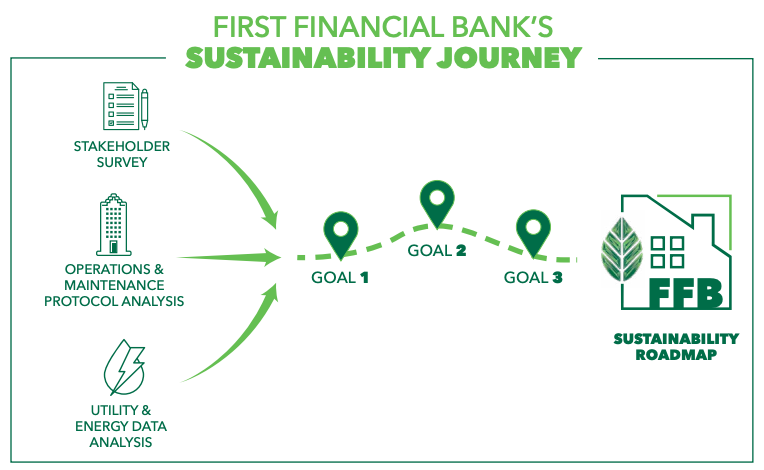
First Financial Bank Sustainability Journey

The Solution

Emerald

Since First Financial Bank has already implemented some sustainability initiatives at its facilities, Emerald’s goal is to assist the bank in building on those existing practices and creating a unified corporate sustainability strategy.


Emerald developed an employee survey to understand values and the importance of sustainability for First Financial Bank staff. The high level of respondents indicated that sustainability is very important to employees. The answers provided in the survey helped Emerald tailor a customized Sustainability Roadmap to fit the company’s existing culture and values.


Analyzing the utility and energy use data from all facilities, Emerald provided a clear view of energy use at all facilities, from large corporate offices to the smallest square-foot bank branches. This data helped identify underperforming locations that would benefit from an energy audit to plan future utility improvements.


A database like this, which tracks energy and utility consumption and cost, is a powerful tool for continued facility improvement.


Similarly, Emerald analyzed the bank’s operations and maintenance (O+M) protocols. By integrating sustainable practices into O+M across all facilities strategically and purposefully, they will be able to increase their level of stewardship.


Finally, Emerald developed a Sustainability Roadmap document with recommendations for short and long-term sustainability goals, business practices, and even product opportunities. This will help the leadership identify immediate opportunities for increased stewardship, develop strategies to improve energy efficiency, and reduce utility costs. All these strategies are designed to engage employees in fulfilling core values and building community involvement around sustainability initiatives.


sustainability roadmap

The Outcome

Emerald

After gathering one year of utility use and cost data from their facilities, the bank plans to continue tracking all locations in this manner. By streamlining the process of data aggregation, they will be able to maintain facility data moving forward, enabling more informed decisions.


First Financial Bank can now identify which facilities are high-energy consumers. Selected properties will undergo energy audits and recommendations for system improvements. Repeating this data-informed process will continue to lower the company’s baseline utility usage and improve environmental impact for years.


By continuing to engage with employees across its facilities, First Financial Bank will be able to cultivate shared values and a unified vision for the future.

FUTURE PLANS (LOOKING AHEAD)

line-3-1

While First Financial Bank is still early in its sustainability journey, the company aspires to be a sustainability leader in the financial industry, on par with larger banks that started developing their stewardship years ago. Many of First Financial Bank’s competitors have not yet communicated a corporate sustainability strategy, leaving room to differentiate themselves and become leaders among their peers.

Download the PDF Version